
Seminole Parole and Probation
The Georgia State Board of Pardons and Paroles defines parole as discretionary release from confinement after an eligible person has served an appropriate part of a prison term. The person remains under state supervision. Probation is a court act. A judge may order it instead of prison or as part of a split sentence. It is not parole, even when both forms of supervision have similar reporting rules.
That split is crucial in Seminole County. The Parole Board makes parole decisions. The Georgia Department of Community Supervision, or DCS, supervises parolees and adult felony probationers by where they live. Seminole County Probation handles the local misdemeanor reporting path. A person released from Seminole County Jail on bond may have no probation term yet. Court disposition and sentencing records should settle that point before any supervision search.
| Record type | Who orders it | Seminole County verification path |
|---|---|---|
| Parole | State Board after a prison term | PAP Parolee Database, then DCS Donalsonville |
| Felony probation | Georgia court | DCS Donalsonville Field Office |
| Misdemeanor probation | Local court | Seminole County Probation and the sentencing court |
| Bond or pretrial release | Court or authorized bond process | Jail release record and court docket, not a parole lookup |
Verify Seminole Post-Release Supervision
Begin with the event that caused release. A county jail row, court case, or GDC record can show whether the person left local custody, served a state sentence, or received probation. Then check the system that holds the supervision record. The county jail roster is only a current-custody tool. A missing name does not establish that supervision ended.
- Check the case disposition or sentencing order to distinguish probation, parole, bond, and sentence completion.
- For a former state prisoner, use the official PAP Parolee Database. The separate TPM lookup concerns possible future parole review.
- For parole or adult felony probation, contact DCS Donalsonville and give enough identifying and case information to route the question.
- For a misdemeanor sentence, contact Seminole County Probation and confirm the sentencing court shown in the case.
- When an official copy is needed, request the relevant record from DCS, PAP, or the court rather than relying on a current jail screen.
The Seminole County released-inmate search paths can help identify the original custody and court record before the supervision check begins. That sequence prevents a local misdemeanor case from being mistaken for state parole.
Two Seminole Supervision Offices
Seminole County has two local reporting paths, and their roles should not be merged. The DCS Donalsonville Field Office serves Seminole County and the wider Pataula Circuit for parole supervision and adult felony probation. The Sheriff's probation page identifies a separate local office for misdemeanor probation.
DCS Donalsonville Field Office
223 S. Wiley Avenue
Donalsonville, GA 39845
Phone: (229) 524-2836
Fax: (478) 216-2085
Monday-Friday, 8:00 a.m.-4:30 p.m.
Seminole County Probation
208 Court Street
Donalsonville, GA 39845
Phone: (229) 524-8737
Fax: (229) 524-6109
The first office is the proper local contact for parole and felony probation. The second is not a statewide parole database. It is the place for local misdemeanor reporting and case-specific check-in directions.
The official DCS field-office image shows the locally assigned state supervision contact. View the DCS Donalsonville source page before relying on office details.
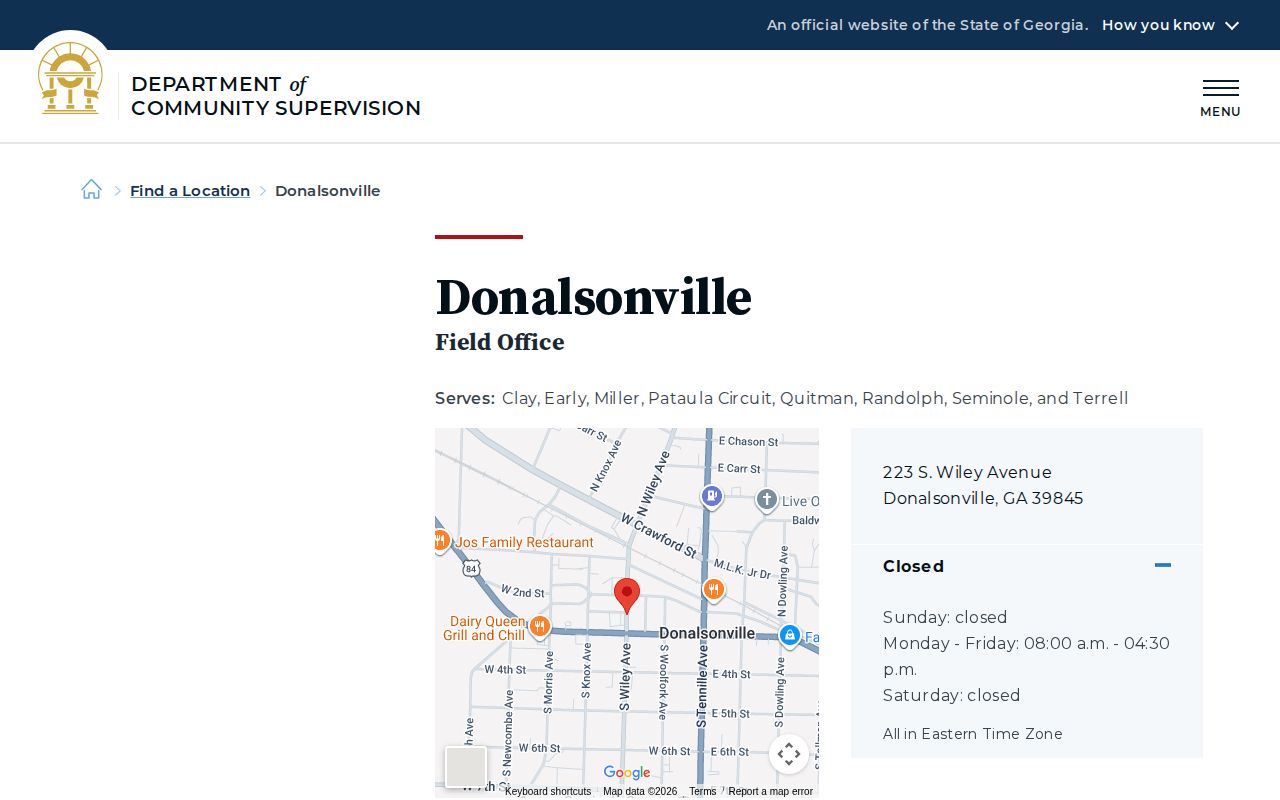
This office covers parole and adult felony probation, while Seminole County Probation remains the local misdemeanor channel.
Seminole Probation Reporting Details
The Seminole County Sheriff's probation page gives unusually specific check-in instructions. Report days are the first five business days of each month, excluding weekends and holidays. During report week, listed hours are 8:00 a.m. to 6:00 p.m. Monday through Friday. At other times the office closes at 5:00 p.m. It closes for lunch each day from noon to 1:00 p.m.
The office is across the road from the Sheriff's Office main entrance. A visitor enters the lobby, signs in at the window, presses the intercom talk button, states a name and the person requested, then waits for a probation officer. Payments are accepted by money order or cashier's check only. The page says there is no cash payment and no drop box. Those directions apply to this local office, not to every DCS case.
Seminole Parole Review Records
Georgia parole review is generally a Board file-review process, not a public courtroom hearing for each inmate. The Inmate TPM Lookup reports whether a Tentative Parole Month exists. A TPM is not a release order. It marks a month for final Board review, after which a parole release date may be set if the required conditions are met.
Board meeting news, events, press releases, and videos may document the public agency's monthly business, but they do not replace an individual status lookup. For a person already released on parole, use the Parolee Database. For a person still in GDC custody, the TPM tool and GDC record answer different questions. Georgia law generally provides parole consideration after one-third of a parole-eligible sentence, while certain serious violent felony sentences must be served in full. Eligibility never guarantees release.
Residence-plan checks, detainers, conduct, and required programs can affect final review. A detainer is a request by another agency to hold or receive a person. The Board may condition a transfer to that detainer, so leaving GDC does not always mean release into the Seminole County community.
Seminole Violations and Warrants
Seminole County does not publish a distinct local absconder list in the researched sources. An absconder is a supervised person whose whereabouts are unknown after failing to maintain required contact. A jail booking may show a parole-violation or probation-violation charge after an arrest, but the absence of such a booking proves nothing about compliance, discharge, or warrant status.
Use PAP or DCS for parole and felony supervision. Use the local probation office for its misdemeanor cases. Conditions may involve reporting, approved residence, lawful conduct, fees, treatment, travel limits, or other terms in the order. Only the supervising agency and court record can establish the actual conditions. If a violation leads to a new Seminole County Jail booking, the roster shows custody, not the final result of the violation case.
Access Seminole Supervision Records
DCS accepts open-records requests by email at openrecords@dcs.ga.gov, by fax at (404) 463-0327, or by mail to the Open Records Custodian, 2 Martin Luther King, Jr. Drive SE, East Tower, Suite 866, Atlanta, GA 30334. The agency notes that Georgia Open Records Act requests may result in billing. Ask for a defined record, date range, and case or identifying number when known.
State parole files and GDC incarceration files are not the same record. PAP decides parole. DCS supervises after release. GDC holds prison custody and incarceration history. A court holds the probation sentence and later orders. For a local misdemeanor, request the order from the sentencing court and confirm reporting status through Seminole County Probation. For parole, the public database is the first check, followed by PAP or DCS when the status needs official confirmation.
When Seminole Supervision Ends
Supervision ends through a formal discharge, expiration, court order, or other action authorized by the agency that controls the case. It does not end merely because the person no longer appears in the Seminole County Jail roster. A parole discharge comes through the state parole process. A probation discharge belongs to the sentencing court and supervising office.
Keep the stages separate: release is departure from custody, supervision is the period of control in the community, and discharge is the formal end of that period. If the public lookup is unclear, obtain the discharge or termination record from PAP, DCS, or the court. That record is stronger than an old roster entry, a tentative date, or an assumption based on time passed.
A completion date on a court order may help frame the request, but it should still be checked against later orders, credits, revocation action, or an early termination. For local misdemeanor probation, ask the sentencing court or Seminole County Probation whether a discharge document exists. For felony probation, DCS and the court are the key sources. For parole, PAP controls the decision record and DCS can confirm the supervising office. This final check matters when an old database entry has not yet changed or when several sentences overlap.
Public Record Search
Sponsored Results